Recorder use on a local level: collating and creating products
Note: This article is reproduced from Ferrantia 51, published in 2007. The original proceedings can be found at this link.
Sussex Biodiversity Record Centre Woods Mill GB-BN5 9SD Henfield
[email protected]
Keywords: data standard, Sussex
biodiversity record centre, data collation, data retrieval
Abstract: A local record centre inhabits a unique space, not only providing local and, to an increasing degree, regional decision makers with crucial biodiversity information, but also supporting the needs of local naturalists and ecologists, from where the vast majority of records in an LRC’s database come from. The dynamic nature of an LRC’s data flow and varied analysis needs requires a standards based approach to data storage and retrieval.
Data coming in from a huge variety of sources, each with subtle (and not so subtle) differences in form and content, require a flexible, modular and scalable framework within which to be stored. The diverse range of information sought by local authorities, NGOs, commercial organisations, members of the public and other users of LRC data require data to be extracted, manipulated and presented in a huge variety of ways. Crucially, data needs to be shared to be made most effective, and the role of the LRC is not only to collect and collate data, but also to pass them on to county recorders, schemes and societies and, of course, the NBN.
To achieve these goals, record centres require information standards to act as the foundation for their work. These standards come in the form of the Recorder software and its underlying ontology, the NBN Data Model. This contribution will show how the Sussex Biodiversity Record Centre is utilising the Recorder platform in its work to build bespoke reporting and analysis systems, with a special emphasis on the Rare Species Inventory (SxRSI); and how the standards based nature of the model allows for us to easily build into a regional, national and now European biodiversity network.
The need for local biodiversity data
The need for high-quality, up-to-date biodiversity data is on the increase as tremendous pressures are placed upon our natural environment from a variety of sources. Key decision makers need to have a clear picture of the state of the environment, and they need it in a timely manner. Local planning guidance in Britain is now taking biodiversity seriously into account (Office of the Deputy Prime Minister 2005). Busy town and country planners need biodiversity data to be presented from a local perspective, and in an easily digestible manner. Government agencies need solid local data to be available at a moment’s notice in order to inform policy. The UK Biodiversity Action Plan requires data with a local flavour for the LBAP (Local Biodiversity Action Plan) process (UK BAP, n.d.). And so the list goes on.
The need for locally informed data containing all the subtleties and nuances conveyed upon them through the knowledge of local naturalists and experts cannot be understated.
Local Record Centres
It is within this local arena that local record centres play their vital role. LRCs in Britain form a network of organisations dedicated to collecting, collating and disseminating species and habitat data. Local record centres provide a level of knowledge, intimacy and detail in regards to local and regional issues that organisations serving the wider national interest cannot achieve. And so local record centres inhabit a unique space; not only providing local and, to an increasing degree, regional decision makers with crucial biodiversity information, but also supporting the needs of local naturalists and ecologists, from where the vast majority of records in an LRC’s database come from. The dynamic nature of an LRC’s data flow and varied analysis needs requires a standards based approach to data storage and retrieval.
Data collected from a variety of sources, each with subtle (and not so subtle) differences in form and content, require a flexible, modular and scalable framework within which to be stored. The diverse range of information sought by local authorities, government agencies, NGOs, commercial organisations, members of the public and other users of LRC data require data to be extracted, manipulated and presented in a number of ways and for a range purposes. Information needs to be presented appropriately to audiences with radically different levels of knowledge; in other words, raw data needs to be converted into information that ultimately informs.
Crucially, data need to be shared to be made most effective, and the role of the LRC is not only to collect and collate data, but also to pass them on to county recorders, schemes and societies and, of course, the UK’s National Biodiversity Network and GBIF, the Global Biodiversity Information Facility.
To achieve these goals, record centres require information standards to act as the foundation for their work. These standards come in the form of the Recorder software and its underlying ontology, the NBN Data Model. Recorder affords a great deal of flexibility not only in the data it can hold but also in the ways those data can be used. This enables local record centres to mould the data stored within the Recorder framework in an almost endless variety of ways while safe in the knowledge that the data they hold will remain compatible with record centres and other organisations throughout the country, thus forming a truly distributed national database.
Sussex Biodiversity Record Centre and Recorder
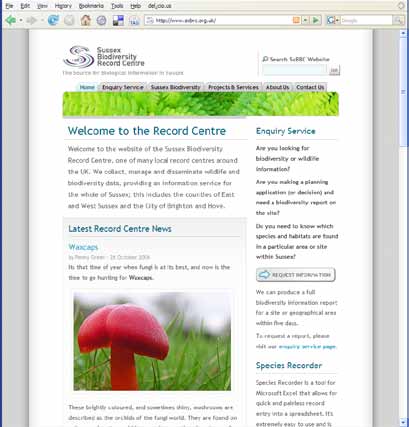
The London and south east region of England is covered by eight local record centres, of which the Sussex Biodiversity Record Centre (SxBRC) is one (SxBRC, n.d.) (Fig. 1). Sussex consists of two counties – East Sussex and West Sussex – and is located on the south coast. SxBRC is a partnership organisation, with the majority of its funding being provided by its partners, which consist of local authorities, national agencies such as Natural England, conservation organisations, NGOs and the private sector.
SxBRC’s partners, commercial enquirers and the general public require that the centre is able to answer biodiversity enquiries in a detailed, digestible, yet expeditious fashion. It is a difficult balance to strike. Maintaining this balance has meant the development of bespoke software that works integrally with Recorder; this not only enables SxBRC to turn-around enquiries extremely quickly (typically in under an hour) while retaining high levels of detail within reports, but, by using Recorder as the core data store, also ensures the data held by the centre remain compatible with the wider community.
In order to present the most appropriate information to enquirers, data flowing into the centre needs to be filtered and checked by both computer and by human-being. In order to manage theses huge amounts of data (now standing at over 1.5 million records), and to avoid overwhelming enquirers with pages and pages of densely packed information, specialised checking software has been developed that enables two members of centre personnel to check incoming records on a weekly basis. The result of this checking and filtering forms the basis of the Sussex Rare Species Inventory and the Sussex Protected Species Register.
Sussex Rare and Protected Species Inventories
The Sussex Rare Species Inventory (SxRSI) and the Sussex Protected Species Register (SxPSR) form two of the longest running components of the standard SxBRC biodiversity report. They form two inventories containing select rare and protected species records within Sussex. Somewhat ironically, the rarer species tend to be more widely recorded than the more common species, particularly in protected areas and nature reserves. For example, there are currently only 198 records of the common Brown Rat, Rattus norvegicus, in the SxBRC database, while there are 684 records of the considerably rarer Water Vole, Arvicola terrestris. In order to temper this proliferation of “rare” records, the “best” record for each species within each 1 km2 is selected for inclusion in the inventories by hand by an expert. Originally, the data were held in Recorder 3, with each incoming record checked by an expert against a set of criteria. If the criteria matched, the record would be included in the relevant inventory. It was a painstaking and laborious process.
With the introduction of Recorder 2002, SxBRC – with the help of developer Mike Weideli, one of the UK’s approved Recorder experts - moved to a much more efficient system that allowed for the two experts co-ordinating the SxRSI and the SxPSR to check incoming records in a fraction of the time and with a much greater degree of accuracy. However, Recorder 2002 is limited to an approximate maximum of one million records and, with the help of the import wizard for importing huge amounts of data, this one million record barrier was quickly reached. Fortunately, the timely release of Recorder 6, with its Microsoft SQL Server database backend, has enabled SxBRC’s data holding to grow well beyond the million record mark.
So while the SxRSI and SxPSR checking and reporting systems are entirely unique to Sussex, and offer information relevant to Sussex only, the data from which these inventories are formed remain compatible with other record centre’s databases and with NBN standards because they exist within the Recorder framework. Recorder is designed as such that data irrelevant to those outside of Sussex will be automatically stripped out on export, leaving only the more generic, universally useful data behind.
The Future
Now that Recorder 6 has been fully integrated into SxBRC’s process, the centre is developing further bespoke reporting tools. The centre is ready to start work on including records into its Biodiversity Action Plan Species Inventory (BAPSI), an inventory much like the SxRSI and SxPSR. By far the largest dataset within SxBRC’s database is that of the Sussex Ornithological Society, standing at over 700,000 records. A tool for producing specialised bird reports has been developed and will soon be deployed into the centre’s enquiry response service. In order to facilitate the development of this new reporting tool, and in order to ensure maximum benefit across the whole community, crucial aspects – such as the latest Birds of Conservation Concern (BoCC) list – were built directly into the taxon dictionary by John Tweddle of the NBN Species Dictionary Project. Building metadata into Recorder in this fashion, rather than keeping them externally in a separate database, ensures they become available for use by all users of Recorder. In a similar vein, further metadata has been incorporated into the taxon dictionary to enable the development of a tool suitable for producing reports for the Higher Level Stewardship agri-environment scheme (DEFRA, 2003). Again, incorporating these metadata into Recorder ensures maximum benefit to users of the software.
Finally, the Kent and Medway Record Centre (KMBRC) has commissioned Dorset Software to produce an add-in that will allow for the integration of survey metadata into Recorder on a much richer level than is currently possible. Based on the existing Sussex Environmental Survey Directory, the new add-in – called SMART, the Survey Metadata And Reporting Tool – has been designed to be as generic as possible and thus it is envisaged will be useful to record centres and other organisations across the country and possibly Europe. By building the tool into Recorder as an add-in, it enables the easy integration of species and habitat data, location data, and the myriad other entities Recorder is capable of storing, with survey metadata. It ensures that record centres and other individuals and organisations can easily install the system and immediately start using it with their data.
Recorder Makes It Possible
So it is in this climate of ever increasing demand and rapidly changing requirements for biodiversity data that Recorder acts as the bedrock of SxBRC’s work. A combination of bespoke software, GIS and standard off-the-shelf tools such as Microsoft Office working integrally with Recorder make the goals of the centre achievable with only relatively small budgets and minimal staff. Recorder’s versatility and comprehensive design has allowed SxBRC to grow rapidly and has almost certainly played no small part in helping the Sussex Biodiversity Record Centre become one of the strongest and most well respected local record centres in the UK.
References
- DEFRA 2003. - Environmental Stewardship guidance. Rural Development Service. Department for Environment, Food and Rural Affairs, UK. Retrieved 23 October 2006 from DEFRA website: http://www.defra.gov.uk/erdp/schemes/es/.
- Office of the Deputy Prime Minister 2005. Planning Policy Statement 9: Biodiversity and Geological Conservation. The Stationary Office, UK. Retrieved 23 October 2006 from http://www.planningportal.gov.uk/england/professionals/en/1020432885185.html.
- Sussex Biodiversity Partnership 2001. - The biodiversity action plan for East and West Sussex, and Brighton & Hove.. Website available at www.biodiversitysussex.org/. Accessed 23 October 2006.
- SxBRC n.d. Sussex Biodiversity Record Centre Website available at www.sxbrc.org.uk.